While the intellectual origins of ‘horizon scanning’ can be traced to Ansoff’s (1975) celebrated work on the recognition of weak signals, the term was popularized and institutionalized in the UK more recently (see Schultz, 2006).
Horizon Scanning implies a search process, which is extended at the margins of ‘the known’ environment and possibly beyond this (Loveridge, 2009) with the aim of identifying emerging issues and events which may present themselves as threats or opportunities for society and policy. In line with this explanation, the UK Department for Environment, Food and Rural Affairs (DEFRA) defined Horizon Scanning in 2002 as “the systematic examination of potential threats, opportunities and likely future developments which are at the margins of current thinking and planning” and, continuing, horizon scanning “may explore novel and unexpected issues, as well as persistent problems or trends“.
At present, various forms of horizon scanning are quite wide-spread (see, e.g. Amanatidou et al., 2011), so much so that it is not easy to take stock of these activities that do not readily fit under any single label.
Könnölä et al. (2011) regard Horizon Scanning as “a creative process of collective sense-making by way of collecting and synthesizing observations that hold potential for the formulation of pertinent future developments and the derivation of actionable implications on decision-making” (c.f. fig. 2).
Despite this variability, horizon scanning offers tested approaches for collecting signals which:
• articulate credible observations about current or imminent changes (sudden or gradual)
• can be meaningfully shared, elaborated, and assessed by the participants
• are felt to be potential indications of new emerging issues that may have received insufficient attention
Two major approaches to identify new emerging issues were followed in Amanatidou et al. (2011). One concentrated on assembling potential emerging issues from a wide variety of data from different ‘signal’ sources (exploratory scanning approach), while the other approach concentrated on identification of core documents (primary signals) that describe substantial parts of potential issues (issue centred approach).
In the first approach emerging issues are identified and described by processing information from different sources, while in the issue centred approach the (preliminary) descriptions of issues are used as a core to identify potential additional signals that could either confirm or deny the ‘real’ emerging of the issue.
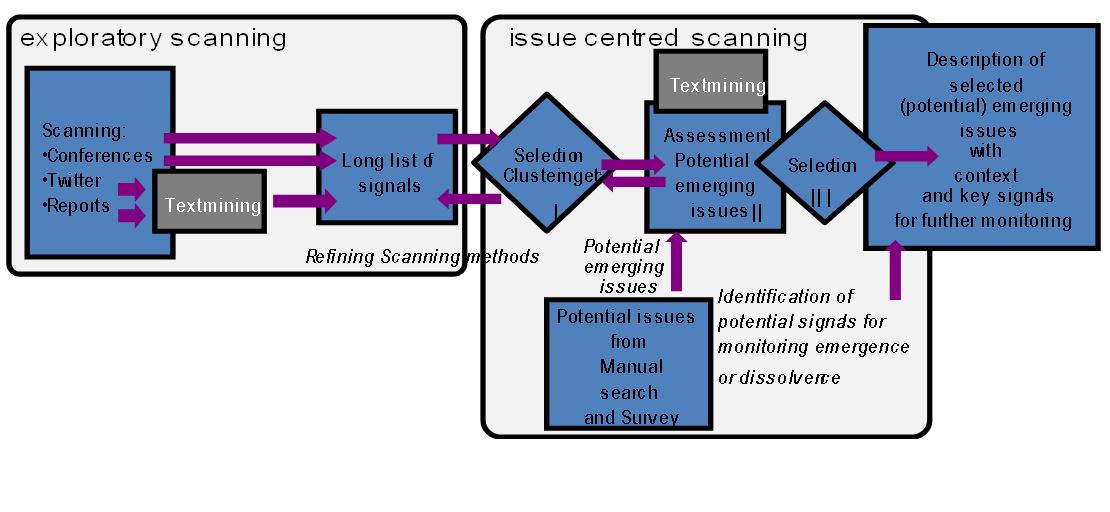
The selection of the best combination of scanning methods and approaches for policy engagement is subject to contextual issues such as objectives, capacities, resources, organisational culture and timeline as well as content issues like the potential risks and urgency around the topic examined, depth and width of implications, public awareness and concerns. With this respect, the following tools and techniques were used in Amanatidou et al. (2011) to identify signals:
• Manual scanning
• Wiki
• Expert survey
• Conferences
• Twitter
• Text-mining